About Adaptable Structures
Construction 5.0 — materials evolution.
We believe in "designing better, right from the start." Our approach fundamentally differs from others in the industry: true sustainability cannot be achieved by relying on single-use resources financed at terms designed for a different era.
Our goal is to enable the construction of livable spaces within a single day, achieved through intelligent design and open architecture. The Anyplace intellectual property offers flexibility for affordable growth at the occupant's own pace. The system's adaptability limits liability by allowing for changes in function during use or ownership. Additionally, it provides the option to sell unneeded modules or parts for reuse — the first manufactured housing asset with a documented, non-zero end-of-life floor value.
Cleantech meets climatech and creates disruptive proptech.
What Anyplace is
Anyplace is an innovative, patented modular building system developed by Adaptable Structures, a New Zealand–based company now in production preparation in the United States through Anyplace Modular LLC. It is designed to fundamentally change how we build by addressing major issues in housing affordability, sustainability, and flexibility.
Design for Industrialization (DfIND)
This is the core methodology. Instead of traditional Design for Manufacture and Assembly (DfMA), which often optimizes existing, sometimes wasteful processes, DfIND designs components specifically for highly efficient, industrialized production. It leverages existing manufacturing capabilities — CNC machining, extrusion infrastructure — to create parts optimized for minimal waste and easy assembly. Adaptable Structures has built the world's first production-proven system using DfIND.
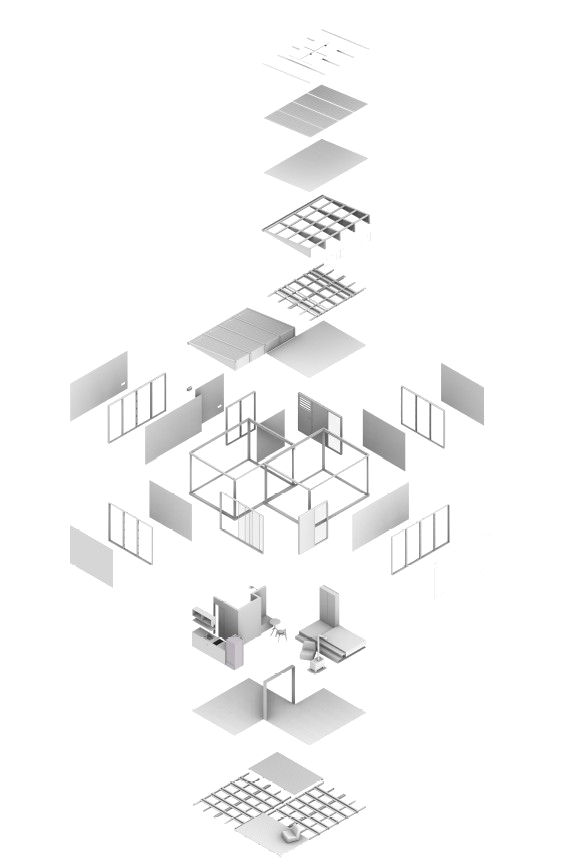
Modular and flexible
Anyplace uses a 46-part system of cleverly designed, interchangeable parts to create a wide range of structures — from single modules to larger dwellings, commercial spaces, and industrial applications. This modularity allows users to add a room, sell a room, or reconfigure their living space incrementally as needs change, avoiding the waste and cost of traditional renovations or overbuilding.
Circular economy at its core
Anyplace is a circular system by design. Material recovery has been measured at 98% across a completed ten-unit production pilot — not projected. The frame is primary aluminum, sourced through a Technical and Economic Discovery Agreement with Hydro North America (signed February 2026) on the largest US aluminum extrusion infrastructure. Under the Divergent Resource Logic framework — published May 2026 at fullboundarycarbon.org — Anyplace generates a net lifecycle of −3.1 to −2.6 tCO₂e per tonne when full boundary accounting is applied.
Affordability
Anyplace tackles affordability by offering a new financial model. Instead of a 30-year mortgage for an entire house, individual rooms or modules can be financed over shorter periods (like a 3–5 year vehicle loan). This incremental approach makes ownership more accessible and adaptable to varying income levels. The structure is financed as personal property — chattel — while the land is mortgaged separately as the appreciating asset it actually is.
Inclusivity and adaptability for life
The design inherently supports aging in place and people with disabilities. Layouts are adjustable, panels can be removed for accessibility upgrades, and features like vertically movable kitchens — adjusting from standard height to wheelchair-accessible height in under an hour with zero waste — are integrated rather than retrofitted.
Versatile applications
Beyond standard residential use, Anyplace modules are suitable for commercial, industrial, and critical disaster recovery applications, offering quick deployment for emergency shelters, classroom and medical infrastructure, or permanent housing — using the same structural frame with reconfigured interior payload.
Proven and patented
Adaptable Structures has invested more than a decade in research and development, self-funded throughout. We have achieved proof of production, demonstrating the system's scalability. Patents were filed with a priority date of March 21, 2014, and granted in three jurisdictions: US9598852B2 (issued August 17, 2017), NZ722998, and AU2015201461B2. Two cease-and-desist notices have been issued and enforced. The patent is material-agnostic and geometry-agnostic, covering the functional principle of the keying-rib joining system — a broad and structurally strong position.
The three commitments
Sustainability
By eliminating waste and building from primary aluminum supplied through hydropower-rich North American extrusion infrastructure, we cut carbon emissions across the full boundary lifecycle. The Anyplace system reaches 98% measured material recovery — not aspirational, validated across a completed production run.
Adaptability
The Anyplace Ecosystem lets buildings grow, shrink, or shift purpose — residential, commercial, industrial, even disaster relief — without tearing anything down. It's Lego for the real world: same parts, different geometry, no waste in the change.
Scale
Built for Industry 4.0's automation and data discipline, DfIND drives Construction 5.0 — industrialized building on existing aluminum extrusion supply lines. Production capacity expands with demand rather than competing with stick-built workforce shortages.
In essence, Anyplace aims to be a paradigm shift in construction, moving toward a future where buildings are not just static structures but dynamic, resource-efficient, and truly adaptable solutions for human needs. Explore the Anyplace Ecosystem →